
Table Of Contents
If you typed “why is the air quality so bad today” into Google, the answer is almost certainly one of two things: wildfire smoke or ground-level ozone.
Smoke gets the headlines. Every summer since 2023, plumes from wildfires in Canada and the western United States have drifted across the Midwest and Northeast, turning skies hazy and triggering air quality alerts for tens of millions of people.
Ozone is the quieter culprit. On hot, sunny, windless days, cities from Texas to Georgia can post unhealthy air with no fire burning anywhere.
This guide is the permanent version of the answers people search for every summer. It explains what the Air Quality Index actually measures, why both problems keep returning, what the numbers mean for your health, and which protections genuinely work.
Bookmark it. The haze will be back.
The Current Situation (Updated July 2026)
This section holds the perishable facts. Everything below it stays true year after year.
As of mid July 2026, smoke from more than 800 active wildfires in Canada, with large clusters in Ontario near the Minnesota border, has pushed air quality alerts across a band of states stretching from Minnesota to Maine. More than 100 million Americans have been under alerts at the peak of the event.
Cities close to the fires, including Chicago and Detroit, saw Air Quality Index readings climb well past the unhealthy range. A heat dome over the central United States trapped the polluted air and carried it south.
Canadian fire activity in 2026 is serious but still well below the record 2023 season, when smoke famously turned New York City skies orange.
What the Air Quality Index Actually Measures
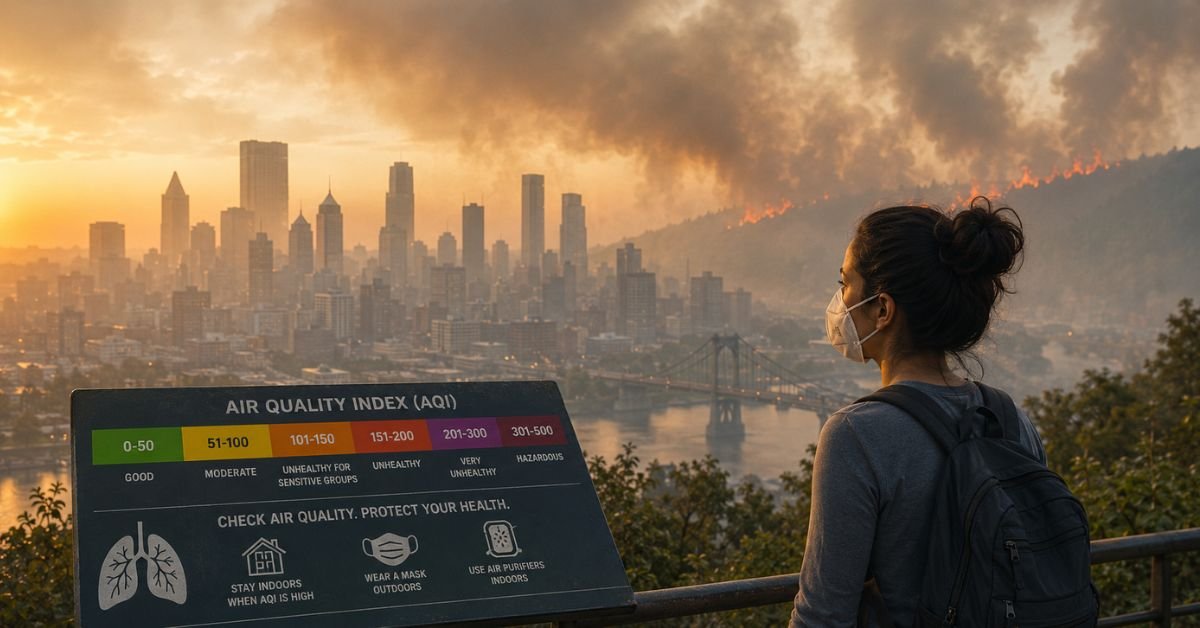
The Air Quality Index, or AQI, is the Environmental Protection Agency tool that converts pollution measurements into a single number from 0 to 500.
Here is the part most people miss. The AQI is not an average of all pollution in the air. The EPA scores up to six pollutants separately, and your AQI is simply the worst single score. That worst pollutant is called the dominant pollutant.
The six pollutants are fine particulate matter (PM2.5), coarse particulate matter (PM10), ground-level ozone, carbon monoxide, sulfur dioxide, and nitrogen dioxide.
During wildfire smoke events, PM2.5 dominates. These are particles smaller than 2.5 microns across, roughly one thirtieth the width of a human hair, small enough to pass deep into the lungs and enter the bloodstream. On hot smoke-free days, ozone is usually the pollutant driving the number.
The Six AQI Categories
| AQI Range | Category | What It Means |
|---|---|---|
| 0 to 50 | Good | Air poses little or no risk |
| 51 to 100 | Moderate | Acceptable, slight risk for unusually sensitive people |
| 101 to 150 | Unhealthy for Sensitive Groups | Children, older adults, and people with heart or lung disease should limit exertion |
| 151 to 200 | Unhealthy | Everyone may begin to feel effects, sensitive groups more seriously |
| 201 to 300 | Very Unhealthy | Health alert, risk increased for everyone |
| 301 to 500 | Hazardous | Emergency conditions, entire population likely affected |
Sensitive groups include people with heart or lung disease, older adults, children, teenagers, and pregnant women.
The 2024 Change That Makes Older Articles Wrong
In May 2024, the EPA tightened the health standard behind the PM2.5 portion of the AQI.
The concentration that earns a “Good” rating dropped from 12.0 micrograms per cubic meter to 9.0. The breakpoints for the Very Unhealthy and Hazardous categories were lowered as well.
The practical effect is that the same physical air now produces a higher AQI number than it did before May 2024. A reading that once sat comfortably in the Good range can now land in Moderate. During severe smoke events, days that would once have been labeled Unhealthy can now tip into Very Unhealthy or Hazardous.
The EPA made the change because newer research showed health damage occurring at PM2.5 levels previously considered safe. Any article, chart, or app still quoting the 12.0 threshold is out of date.
Villain One: Why Wildfire Smoke Returns Every Summer
Three ingredients combine to produce America’s smoky summers, and all three are becoming more common.
- Bigger, longer Canadian fire seasons: Canada’s boreal forest is enormous, and its fire seasons have intensified sharply. The 2023 season burned roughly 15 million hectares, more than double the previous record set in 1989 and about seven times the historical annual average, according to research published in Nature Communications. The seasons since have not matched 2023, but multi-million-hectare years that were once rare are now routine.
- Weather patterns that deliver the smoke south: Smoke does not stay where the fire is. When the jet stream dips or a low-pressure system rotates over eastern Canada, plumes are steered directly into the American Midwest and Northeast. A heat dome makes it worse by trapping the smoke near the ground instead of letting it disperse, which is exactly what happened in July 2026.
- A warming, drier baseline: Hotter springs melt snowpack earlier, dry out forests faster, and extend the window in which fires can ignite and spread. Climate researchers found that human-driven warming more than doubled the likelihood of a burn as large as 2023 across much of Canada. The individual bad summer is weather. The pattern of repeated bad summers is climate.
Add domestic fires in the American West, which contribute millions of burned acres of their own in a typical season, and there are more weeks of the year when smoke is in the sky somewhere over the United States.
Villain Two: Ozone, The Smoke-Free Bad Air Day
If your air quality alert arrives on a clear, blazing hot day with no smoke in sight, you are almost certainly looking at ground-level ozone.
Ozone is not emitted directly by any tailpipe or smokestack. It forms in the air itself, when nitrogen oxides from vehicles and industry react with volatile organic compounds in strong sunlight. Heat accelerates the reaction. Stagnant air lets the product accumulate.
That chemistry explains the pattern searchers notice every year. Ozone alerts cluster on hot, sunny, windless summer afternoons, peak in the late afternoon, and hit hardest in sprawling, traffic-heavy metros across the South and Southwest.
It also explains the classic advice on ozone action days. Exercise in the early morning, before the day’s sunlight has had time to cook that day’s ozone. This is the opposite of a smoke event, where the timing of the plume matters more than the clock.
High in the stratosphere, ozone shields the planet from ultraviolet radiation. At nose level, the same molecule inflames airways. Air quality scientists compress this into a phrase worth remembering: good up high, bad nearby.
What Bad Air Actually Does To Your Body
PM2.5 is dangerous precisely because of its size. Larger dust particles get trapped in your nose and throat. Fine smoke particles slip past those defenses, lodge in the deepest parts of the lungs, and cross into the bloodstream. Ozone works differently, chemically irritating the airway lining, but the at-risk groups overlap almost completely.
Short-term exposure to either can cause stinging eyes, scratchy throat, coughing, headaches, and fatigue in healthy people. For people with asthma, COPD, or heart disease, it can trigger attacks, arrhythmias, and hospital visits. Children breathe faster, and their lungs are still developing, which makes them more vulnerable than adults at the same exposure.
The effects are not limited to the visibly hazy days. The research behind the EPA’s 2024 standard change found measurable harm at concentrations low enough that the sky looks clear.
One honest caveat. A single smoky week is not a health catastrophe for most healthy adults. The concern is repeated seasonal exposure, and the people who carry the real risk are the sensitive groups listed above.
What Actually Helps
Not everything sold or shared during bad air events works. Here is what the evidence supports.
- Stay indoors with windows closed: This is the single most effective step during a smoke event, according to the EPA. Run air conditioning on recirculate so you are not pulling smoky outdoor air inside.
- Run a HEPA air purifier in the room where you spend the most time: A properly sized HEPA unit is the biggest single reduction in indoor PM2.5 you can buy. Match the clean air delivery rate to your room size, and close the door to that room so the purifier is not fighting the whole house.
- Or build a Corsi-Rosenthal box: A 20-inch box fan, four MERV 13 furnace filters, and duct tape. EPA chamber testing found these DIY cleaners reduced simulated wildfire smoke about as well as manufactured HEPA units costing several times more, and safety testing found no fire risk with modern certified fans. One caution from the same research community: replacement filters over a long smoke season can end up costing more than the original build, so budget for the season, not the afternoon.
- Upgrade your HVAC filter to MERV 13: If your central system accepts it, this turns your whole heating and cooling system into a smoke filter. Filters load up quickly during smoke events, so keep spares.
- Wear a NIOSH-approved N95 or KN95 outdoors during smoke events: These are the only common masks that filter PM2.5 effectively, and only when fitted snugly. Surgical masks, cloth masks, and bandanas do not filter fine smoke particles in any meaningful way. Note that masks help with particles, not ozone, which passes through any filter fabric.
- Time your outdoor activity: During smoke events, follow the plume forecasts on AirNow. On ozone days, shift exercise to early morning. In both cases, hard exercise multiplies the volume of polluted air you inhale, so easing off on bad days is not overcaution; it is arithmetic.
- Avoid adding indoor pollution: Frying food, burning candles, vacuuming without a HEPA vacuum, and using gas stoves all add fine particles to indoor air at exactly the moment your home is supposed to be a refuge.
For guidance on when specific groups should limit activity or mask up, the EPA publishes an activity table for each AQI category on AirNow, and it is the sensible reference rather than any fixed rule of thumb.
How To Check Your Air, The Right Way
AirNow.gov is the official EPA source, and its Fire and Smoke Map combines government monitors with low-cost sensors for a street-level picture.
Two tips make the numbers far more useful.
First, check the NowCast rather than yesterday’s average. During fast-moving smoke events, the EPA weights the most recent hours more heavily so the number reflects what is outside your window right now.
Second, understand that different apps can show different numbers for the same city. Some sensor networks and foreign apps use different formulas or older breakpoints. When in doubt, trust AirNow.
Did You Know?
In Canada’s record 2023 season, lightning started 59 percent of the fires but caused 93 percent of the total area burned. Lightning strikes ignite fires in remote stretches of boreal forest where crews cannot easily reach them, so those fires burn for months. The largest single fire that year, near the La Grande Reservoir in Quebec, charred over 1.2 million hectares by itself, an area larger than the state of Connecticut.
Frequently Asked Questions
Why is the air quality bad when I cannot see or smell smoke?
Two reasons. PM2.5 at unhealthy levels is often invisible, and your nose stops registering smoke odor after a short time. Moreover, on clear hot days, the culprit may be ozone, which has no visible haze at all. Checking the AQI matters more than looking out the window.
How long does wildfire smoke last?
Individual smoke waves typically pass through a region in two to five days, depending on wind patterns. However, during active fire seasons, new plumes can arrive in repeated waves for weeks.
Is it safe to run air conditioning during a smoke event?
Yes, and you should. Set it to recirculate mode. Window units and central systems that draw outdoor air should have fresh air intakes closed if possible.
Does rain clear wildfire smoke?
Partially. Rain washes some particles out of the air, but light rain during a heavy smoke event often makes only a modest difference. A change in wind direction usually matters more. Rain and cloud do help with ozone, since the formation reaction needs sunlight.
When should I wear a mask outside?
Follow the EPA activity guidance for the current AQI category on AirNow. As a general pattern, sensitive groups benefit from an N95 once smoke pushes air into the Unhealthy for Sensitive Groups range, and everyone benefits once it reaches Unhealthy and beyond.
Why does my weather app show a different AQI than AirNow?
Different apps pull from different sensor networks, and some use older breakpoints or foreign index formulas. AirNow uses the current official EPA method.
Are air quality alerts new, or is this getting worse?
Alerts are not new, but their frequency in the Midwest and Northeast has risen sharply since 2023 as Canadian fire seasons have intensified. What was once a western US problem is now a national one.
Key Takeaways
Summer bad air has two causes: wildfire smoke, which travels thousands of miles from its source, and ground-level ozone, which forms in place on hot sunny days. The EPA tightened the PM2.5 scale in May 2024, so the same smoke now produces higher AQI numbers than older articles suggest. Smoky summers recur because record-scale Canadian fire seasons, smoke-steering weather patterns, and a warmer, drier climate now line up almost every year. Indoors with filtration beats everything else, whether that is a HEPA purifier or a homemade Corsi-Rosenthal box, with a fitted N95 for time outside. Check AirNow.gov rather than the sky, because the most harmful pollution levels are frequently invisible.
Preparing before the haze arrives costs an afternoon. Waiting until the sky turns orange costs a lot more.
About The Author
