
Table Of Contents
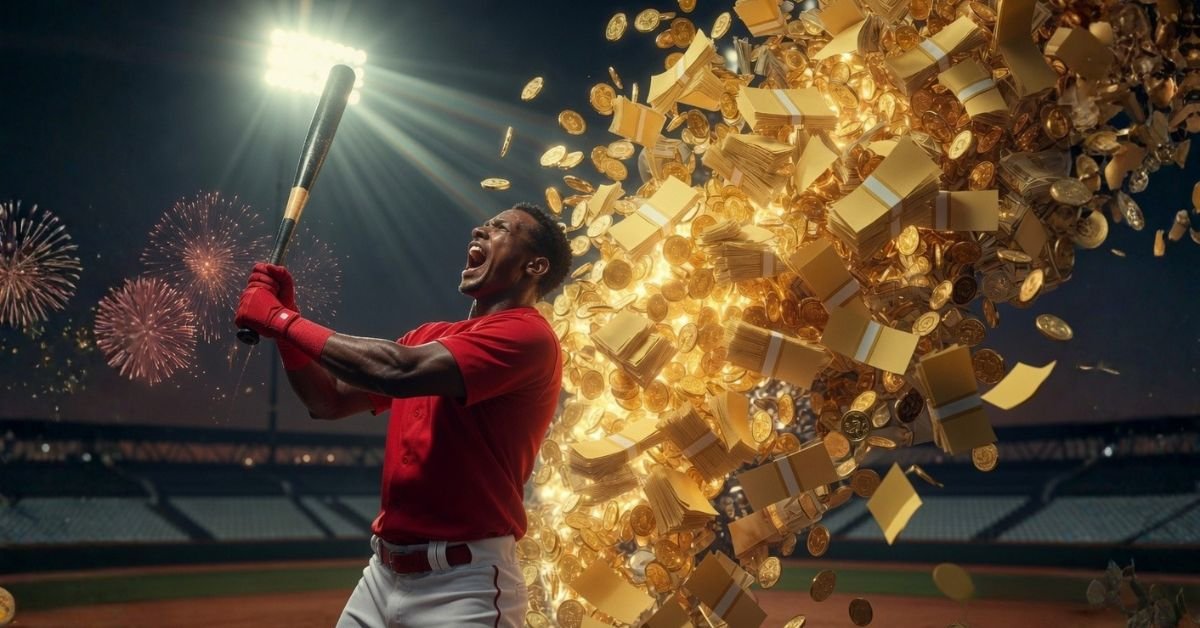
The Home Run Derby winner gets a $1 million check.
He does not keep $1 million. Not even close.
This post covers both halves of that story, first, the full prize structure and what every participant earns. Then the part almost nobody publishes: the actual take-home math after federal, state, and city taxes carve up the headline number.
Updated after the 2026 Derby in Philadelphia, where Jordan Walker of the St. Louis Cardinals won the title.
The Prize Structure: A $2.5 Million Pool
Major League Baseball funds a $2.5 million prize pool for the Home Run Derby. Eight players compete, and every one of them gets paid.
| Result | Prize Money |
|---|---|
| Winner | $1,000,000 |
| Runner-up | $500,000 |
| Six remaining participants | $150,000 each |
| Longest home run bonus | $100,000 extra |
Three details matter here.
The winner and runner-up receive flat prizes of $1 million and $500,000. They do not receive the $150,000 participation payment on top of that. That amount is reserved for the six players who do not reach the final.
The longest home run bonus is separate and stackable. Whoever hits the single farthest home run of the night, in any round, collects an extra $100,000 on top of his finishing prize.
The maximum possible payday is therefore $1.1 million: win the event and hit the biggest blast of the night.
What Every Player Earned In 2026
The 2026 Derby at Citizens Bank Park showed exactly how the payouts land in practice.
| Player | Team | Result | Total Earned |
|---|---|---|---|
| Jordan Walker | St. Louis Cardinals | Winner | $1,000,000 |
| Kyle Schwarber | Philadelphia Phillies | Runner-up | $500,000 |
| Junior Caminero | Tampa Bay Rays | Semifinalist, longest home run | $250,000 |
| Willson Contreras | Boston Red Sox | Semifinalist | $150,000 |
| Bryce Harper | Philadelphia Phillies | First round | $150,000 |
| Munetaka Murakami | Chicago White Sox | First round | $150,000 |
| Jac Caglianone | Kansas City Royals | First round | $150,000 |
| Ben Rice | New York Yankees | First round | $150,000 |
Walker needed three consecutive home runs on his final ball to tie Schwarber in the final. He hit four, won the round 12 to 11, silenced a hostile Philadelphia crowd, and became the first Cardinals player ever to win the Derby.
Junior Caminero lost in the semifinals but still walked away with $250,000. His semifinal shot, measured at 492 feet, was the longest home run of the night and triggered the $100,000 bonus on top of his participation payment.
What The Winner Actually Takes Home
Now, the part that the headline numbers never show.
Derby prize money is ordinary taxable income in the United States. It is not a gift, and it is not capital gains. It stacks on top of the player’s salary, which means for any established major leaguer, it lands almost entirely in the top federal bracket of 37 percent.
Then geography takes its cut. Athletes are taxed on income where it is earned, a system commonly called the jock tax. The 2026 Derby took place in Philadelphia, which meant two additional layers were applied: Pennsylvania state income tax at a flat 3.07 percent and the Philadelphia non-resident wage tax, which runs at roughly 3.44 percent for players who live outside the city.
Here is the estimated math on Jordan Walker’s $1 million prize.
| Line Item | Rate | Amount |
|---|---|---|
| Prize money | $1,000,000 | |
| Federal income tax | 37 percent | -$370,000 |
| Pennsylvania state tax | 3.07 percent | -$30,700 |
| Philadelphia wage tax | approx. 3.44 percent | -$34,400 |
| Estimated take-home | approx. $565,000 |
Medicare payroll taxes shave off an additional 2.35 percent at this income level, roughly $23,500, bringing the realistic figure closer to $540,000.
Two caveats keep this honest. These are estimates, not Walker’s actual tax return. His home state may also claim the income and then credit the tax already paid to Pennsylvania, which slightly shifts the final amount depending on residency. Moreover, if his representation agreement applies a commission to award money, the net drops further. Not all agent contracts treat prize money the same way, so no assumption is built into the table.
The clean summary: a Home Run Derby champion keeps a little more than half of the headline prize. Roughly $540,000 to $565,000 of the $1 million, depending on residency and the host city that year.
Still an extraordinary rate of pay for one evening of swinging. However, no winner has ever deposited the full million.
Why The Money Means More To Some Players
MLB pay is extremely uneven. Stars sign contracts worth hundreds of millions. Young players who have not yet reached salary arbitration earn near the league minimum regardless of performance.
Half of the 2026 field sat in that second category. Caglianone earned a 2026 salary of $784,000, Caminero $794,800, Walker $799,400, and Rice $845,800.
For all four, the $1 million top prize exceeded their entire season salary. Walker literally earned more in one night than in 162 games.
For Schwarber and Harper, both on enormous long-term contracts, the payouts were closer to symbolic. This gap reflects a familiar pattern: hungry young sluggers eagerly accept Derby invitations, while many established superstars decline. The fatigue risk is the same for everyone. The financial upside is only life-changing for players who are not yet rich.
How The Prize Money Got This Big
The Derby dates back to 1985, but the seven-figure prize is a recent addition.
In 2019, MLB raised the purse to its current structure: $2.5 million total, $1 million to the winner.
The timing produced a famous storyline. Pete Alonso of the New York Mets won the 2019 Derby as a rookie, earning $555,000, and won again in 2021, earning $676,775. His two Derby titles paid him $2 million in combined earnings, more than his salaries from both seasons combined.
The pattern has repeated. Cal Raleigh won the title in 2025, and Walker in 2026 became the latest pre-arbitration player to out-earn his own salary in a single night.
Trivia
In the 1990s and 2000s, the Derby ran a fan promotion in which each competitor was paired with a contest winner in the stands. The fan’s reward depended on how well their assigned slugger performed, and the top prize was $250,000 toward buying a new home. The players hit the homers. The fans got the house money.
How The Derby Compares To Other One Night Prizes
A $1 million single-event prize is rare in North American team sports.
The NBA’s All-Star Saturday skills events have historically paid their winners in the low six figures, a fraction of the Derby check. Golf and tennis majors pay their champions several million dollars, but those require four days or two weeks of competition against full fields.
Measured as money per minute of actual competition, the Home Run Derby is arguably the most lucrative regularly scheduled event in American sports. A finalist swings a bat for well under an hour.
The Money Beyond The Purse
The official prize is only part of the financial picture.
Many player contracts contain All-Star bonus clauses. Selection to All-Star festivities can trigger payments worth tens of thousands of dollars, entirely separate from what MLB pays for the Derby itself.
The marketing value is harder to price but very real. A dramatic Derby win puts a young player in front of a national audience in a way regular-season games rarely do. Bat brands, trading card companies, and apparel sponsors notice. For a player like Walker, the long-term endorsement upside of a viral Derby comeback may eventually exceed the prize itself.
Sponsors and host cities also attach promotional giveaways to the event each year, adding gear and perks on top of the cash.
Frequently Asked Questions
How much does the Home Run Derby winner get?
$1 million, a structure in place since MLB raised the purse in 2019. Before that increase, Derby payouts were a small fraction of today’s figure.
Do losing players get paid?
Yes. The runner-up earns $500,000, and the six other participants earn $150,000 each. The guaranteed $150,000 alone is close to two months of pay for a league-minimum player.
How is the longest home run bonus decided?
The $100,000 goes to the single farthest home run of the night in any round, based on MLB’s ball-tracking distance measurements. In 2026, it came down to a matter of feet, with Caminero’s 492-foot semifinal shot narrowly beating a Willson Contreras blast for the bonus.
Does the prize money count against a team’s payroll?
No. MLB pays the prize as part of the event, not by the player’s club, so it does not affect the team’s competitive balance tax calculations.
Is the prize money taxed?
Yes, as ordinary income at the federal level plus state and local taxes in the host city. A winner typically keeps roughly $540,000 to $565,000 of the $1 million, depending on residency and the event’s location that year.
The Bottom Line
The structure is simple. A $2.5 million pool. $1 million to the winner. $500,000 to the runner-up. A guaranteed $150,000 for showing up. An extra $100,000 for the night’s longest home run.
The reality is more layered. Taxes claim close to half the winner’s check. Young players near the league minimum treat the event as a financial windfall for their careers, while nine-figure stars play mostly for the trophy.
That contrast is the real story of the Home Run Derby. It is the one night on the baseball calendar where a pre-arbitration kid can step into a batting cage, take a few dozen swings, and out-earn his own season.
Jordan Walker did exactly that in Philadelphia.
About The Author