
Table Of Contents
The President of the United States is currently flying in a jet built for a foreign royal family.
That sentence sounds like fiction.
It is the actual state of presidential aviation in 2026, and the story behind it involves a bankrupt Russian airline, billions of dollars in Boeing losses, and the largest unsolicited foreign gift in American government history.
This guide covers the full picture. The Jet flying now, the delayed replacements, the retiring fleet, the history of the name, and the helicopter that everyone confuses with the plane.
The Jet Is Flying The President Right Now
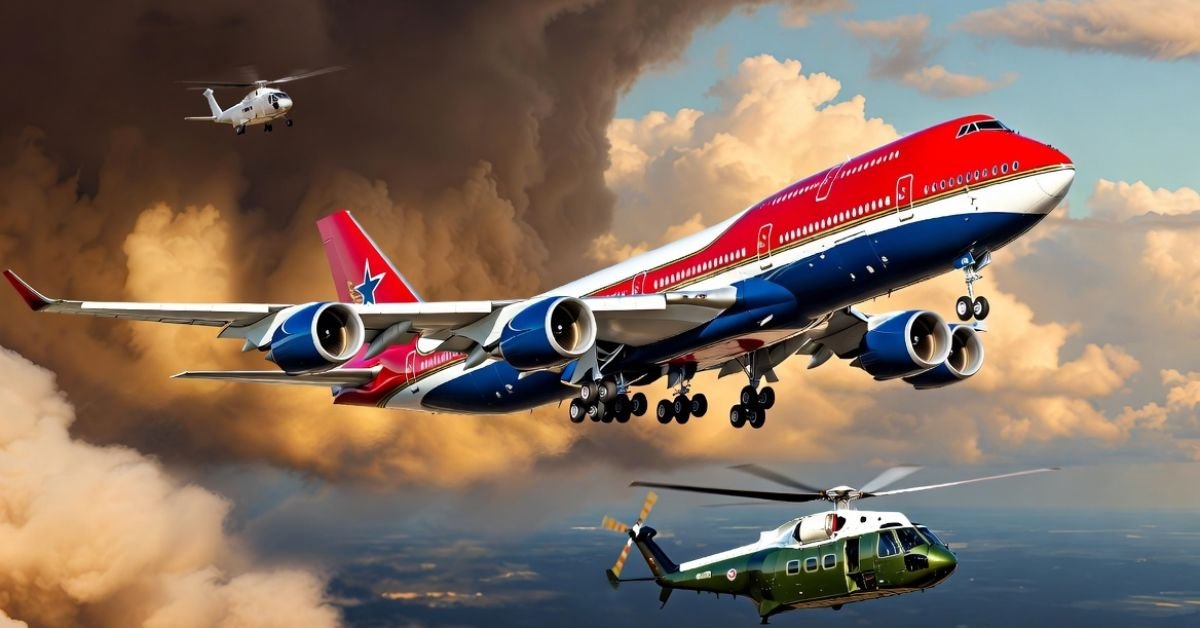
On June 19, 2026, a converted Boeing 747-8 landed at Joint Base Andrews in Maryland and took over as the primary presidential aircraft.
The Air Force calls it the VC-25B Bridge. The word Bridge is doing important work in that name. This is an interim aircraft, meant to fill a gap of several years until two purpose-built presidential jets arrive from Boeing.
Its history is unlike any presidential aircraft before it.
The Jet was built in 2012 as a Boeing Business Jet and delivered to the Qatari royal family, who operated it through the Qatar Amiri Flight. In 2025, the government of Qatar donated the aircraft to the United States.
Based on conversion cost estimates provided by Air Force officials, the Jet is valued at roughly $ 400 million. That makes it the largest unsolicited foreign gift ever accepted by the United States government.
The gift generated genuine controversy in Washington. Critics questioned whether the aircraft carrying the American president should be provided by a foreign government at all, and raised concerns about security and precedent. The administration and Air Force leadership argued the need was urgent, since the existing fleet was aging and the purpose-built replacements were years behind schedule. The Air Force publicly described an interim aircraft as an absolute imperative.
Whatever side of that debate you land on, the conversion itself was fast by any standard. Defense contractor L3Harris completed the modification and flight testing in about ten months. The work included presidential-grade secure communications, security systems, and a new red, white, and blue livery.
According to reported plans, the aircraft is expected to go to the Trump Presidential Library at the end of the current presidential term. That remains a stated intention rather than a completed arrangement, and it is worth watching whether it holds.
The Real Story: Boeing’s Troubled Replacement Program
The Bridge jet exists because of a much bigger story that most coverage skims. The program to build the next permanent Air Force One has become one of the most scrutinized and financially painful defense contracts in recent memory.
Here is the full picture.
In 2018, Boeing signed a fixed-price contract worth $ 3.9 billion to deliver two brand-new, fully outfitted presidential 747-8 jets, designated VC-25B. Fixed price is the key term. Under this structure, Boeing absorbs every cost overrun rather than passing it to taxpayers.
The two airframes have their own strange origin. They were originally built for Transaero, a Russian airline. Transaero went bankrupt before it could take delivery. The two unused jumbo jets, which had never flown a single commercial passenger, sat in storage in the California desert until the Air Force purchased them for the program.
On paper, this looked like a bargain. Two nearly new 747-8s at a distressed price, converted under a contract that protected the government from overruns.
In practice, the program became a slow-motion disaster for Boeing.
The first delivery was planned for 2024. Wiring design errors forced rework. Interior suppliers ran into trouble. Supply chain problems and workforce shortages at the Texas conversion facility compounded the delays. The schedule slipped again and again.
The Air Force now projects that the first fully outfitted VC-25B will enter service around 2028 or 2029. That is four to five years late.
Because of the fixed-price structure, Boeing has absorbed losses on the program running into the billions of dollars. The Air Force, meanwhile, is still budgeting over a billion dollars across the next five years for its side of the program.
The delay is what forced the Bridge solution. It also created a fleet situation without precedent: a gifted, foreign-built jet carrying the president, two 36-year-old jets on standby, and two half-finished replacements in a Texas hangar.
When the purpose-built jets finally arrive, they will be significantly larger than anything that has carried a president before. The 747-8 is about 250 feet long with a wingspan of nearly 225 feet, powered by four General Electric GEnx engines. It is also the final passenger version of the 747 line, which means the president will fly the last of the jumbo jets long after commercial airlines have retired theirs.
The Old Fleet: 36 Years Of Service
Before June 2026, the Air Force One role was held by two identical Boeing 747-200s, designated VC-25A.
The two jets entered service in 1990 under President George H. W. Bush. They carried every president from Bush through Trump across nearly four decades of summits, state visits, war zone flights, and crises.
The VC-25A was never a normal 747. Its defining features include secure command-and-control systems that allow the president to run the government from the air, aerial refueling capability for effectively unlimited range in an emergency, a medical suite with an operating table and a doctor on every flight, and hardened electronics designed to withstand electromagnetic interference. The interior spans roughly 4,000 square feet across three levels, with a presidential office, a conference room, and dedicated areas for staff, the Secret Service, and the press.
The most famous day in the fleet’s history came on September 11, 2001. The Jet carrying President George W. Bush flew unpredictable routes with fighter escorts amid fears that the aircraft itself was a target. For several hours, the plane functioned exactly as designed: as a survivable airborne command post in a national crisis.
The two VC-25As are not retired. They remain in service as backup aircraft, and the Air Force has stated there are no plans to retire them until both purpose-built VC-25Bs are operational. After that, the stated plan is for the jets to go to museums, with retirement projected around 2029.
What Air Force One Actually Means
Here is the detail that reframes everything above. Air Force One is not a plane. It is a radio call sign.
Air Force One is the air traffic control designation for any United States Air Force aircraft carrying the sitting president. The name follows the president, not the aircraft. If the president boards a small Air Force jet, that Jet becomes Air Force One for the duration of the flight.
The callsign exists because of a real incident. In 1953, President Dwight Eisenhower’s aircraft used the callsign Air Force 8610. A commercial Eastern Air Lines flight with a similar flight number entered the same airspace, and the resulting confusion alarmed controllers. The unique callsign Air Force One was adopted afterward, and no other aircraft in American airspace may use it.
The same convention runs across the military. A Marine Corps helicopter carrying the president is Marine One. A Navy aircraft is Navy One, a callsign used exactly once, when President George W. Bush flew to an aircraft carrier in 2003.
This is why the fleet transition described above changes every physical aircraft in the story without changing the name. Whatever the president boards, the radio says the same two words.
The Helicopter: Marine One, Not Air Force One
The green-and-white helicopter that lands on the White House lawn is the most commonly misidentified aircraft in America. It is not Air Force One. It is Marine One.
The helicopter fleet is operated by Marine Helicopter Squadron One, known as HMX-1, based in Quantico, Virginia. The squadron has flown presidents since Eisenhower became the first to use a helicopter in 1957.
The primary presidential helicopter today is the Sikorsky VH-92A, which the Marine Corps has been fielding as the successor to the long-serving VH-3D Sea King and VH-60N White Hawk.
Marine One rarely flies alone. It travels in a formation of identical helicopters that swap positions in flight, so observers cannot tell which one carries the president. The practice is informally known as the presidential shell game.
The helicopter handles short hops, most commonly from the White House South Lawn to Joint Base Andrews. The moment the president steps from the helicopter to the Jet, the active callsign shifts from Marine One to Air Force One.
What Happens Next
The rest of this decade will see the replacement of every physical aircraft in the presidential fleet.
The Qatari-gifted Bridge jet flies the president today. The two 1990 jets stand by. The purpose-built VC-25Bs are projected to arrive around 2028 or 2029, at which point the old jets are slated for museums and, according to reported plans, the Bridge jet heads to a presidential library.
Every plane changes. The callsign does not. That has been true since the 1950s, and it is the one detail in this story guaranteed to outlive every aircraft in it.
Frequently Asked Questions
How many Air Force One planes are there?
Strictly speaking, none, because Air Force One is a callsign rather than an aircraft. In practical terms, the current presidential fleet consists of one Bridge 747-8 serving as the primary aircraft, two VC-25A jets as backups, and two purpose-built VC-25Bs undergoing conversion for delivery around 2028 or 2029.
Is the new Air Force One really a gift from Qatar?
Yes. The 747-8, now serving as the primary presidential aircraft, was donated by the government of Qatar in 2025 and converted by L3Harris. It is valued at roughly $ 400 million based on official conversion rates.
Why is the new Boeing Air Force One so late?
The purpose-built jets were contracted in 2018 for planned delivery in 2024. Wiring design errors, supplier failures, and workforce shortages pushed delivery to a projected 2028 or 2029. Boeing bears the overrun costs under its fixed-price contract and has reported billions in losses on the program.
Can Air Force One refuel in the air?
The VC-25A jets that served from 1990 were built with aerial refueling capability, giving them effectively unlimited range in an emergency.
Is the president’s helicopter called Air Force One?
No. The helicopter is Marine One, operated by Marine Corps squadron HMX-1. The Air Force One callsign applies only to Air Force fixed-wing aircraft carrying the president.
About The Author